

By Raoul Craemer, Evaluation Adviser and Nattlie Smith, Branch Manager, Strategic Insights Branch at the National Indigenous Australians Agency
With National Reconciliation Week underway, it’s timely to reflect on how the Australian Public Service (APS) can strengthen its work with First Nations peoples. One important contribution is through high-quality evaluation that helps government better understand how policies and programs are affecting First Nations peoples and identify opportunities for improvement. As we strive to make a meaningful difference, doing evaluation well is essential.
At the National Indigenous Australians Agency (NIAA), our evaluation practice is guided by the Indigenous Advancement Strategy (IAS) Evaluation Framework and the Productivity Commission’s Indigenous Evaluation Strategy. At the heart of both is a shared principle of centring First Nations peoples’ perspectives and knowledge throughout the evaluation lifecycle. These principles guide how we plan, commission, design, conduct, analyse, report on, and learn from evaluations.
What does this look like in practice?
The NIAA’s Indigenous Evaluation Committee (IEC) provides a strong example of how the APS can support First Nations leadership in evaluation and contribute to the Priority Reforms under the National Agreement on Closing the Gap.
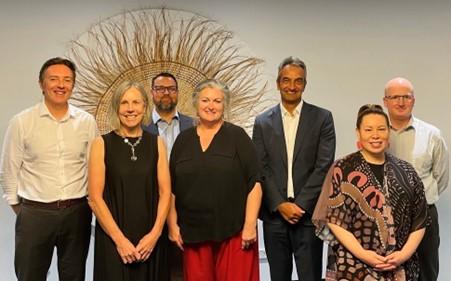
A group photo of NIAA’s independent Indigenous Evaluation Committee members Dr Fiona Cram, Tony Kiessler, Professor Michelle Dickson and Jason Ardler (Chair of the Committee) alongside senior officials from NIAA (Dr Simon Gordon and Nattlie Smith) and Treasury (Dr Shane Johnson, Head of the APS Evaluation Profession). Copyright and credits: Nattlie Smith
The 4 Indigenous members of the IEC provide independent technical and strategic advice on evaluations commissioned by NIAA. The Committee also includes a senior official from Treasury’s Australian Centre for Evaluation, ensuring Indigenous perspectives and insights inform broader APS evaluation practice.
Jason Ardler, a Yuin man from the NSW South Coast and Chair of the IEC, describes this role succinctly:
‘We’re really there to ensure that the approaches to program design and evaluation are more reflective of First Nations ways of doing. It's about promoting genuine co-design that moves away from ‘here’s a program or here’s a solution, what do you think?’ to asking ‘do we agree what the problem or aspiration is, what does success look like and how should we get there?’
Through its discussions and feedback, the IEC has consistently encouraged NIAA and its evaluation partners to go deeper, to invest in stronger relationships, create space for meaningful sense-making, and build feedback loops that strengthen learning, accountability and decision-making.
This experience mirrors a growing Indigenous-led evidence base on what enables high-quality evaluation. A recent scoping review by Summer May Finlay and colleagues found that when commissioners moved beyond transaction-focused approaches and instead prioritised relationships, cultural safety and reciprocity, evaluations were more likely to support genuine two-way learning, culturally safe feedback loops, accountability to community, and findings that are meaningful for both communities and policy decision‑makers. This evidence highlights commissioning as a critical leverage point for improving evaluation quality and usefulness across the APS.
Evaluation and data as a change lever
The Commonwealth Priority Reforms Roadmap: Building APS Readiness for Transformation recognises culturally informed evaluation as essential for transforming how APS agencies engage and partner with First Nations peoples. Evaluation plays a central role not only in building evidence, but also in strengthening change levers across partnership, systems and governance.
Embedding Indigenous Data Sovereignty principles in evaluation brings broader benefits to data quality, integrity and system design by ensuring data are collected, accessed, used and managed according to cultural values and principles of Indigenous communities. The APS has committed to this through the Framework for Governance of Indigenous Data, which provides First Nations peoples greater agency over how their data are governed and used.
Where to from here?
Indigenous-led and Indigenist evaluation practice continues to evolve. The Gilibanga Network, established in late 2024, brings together Blak evaluators and trusted allies with a shared ambition to redefine how impact is understood, measured and valued.
There is also a growing ambition to strengthening collective capability in Indigenist evaluation. Bobby Maher and colleagues define collective capability as
‘people coming together in a relational, collaborative environment to pursue a common goal, where cultural values are prioritised, knowledge is shared and the process is as important as the outcome.’
Bobby Maher et al (2026) Collective Capability Within Indigenist Evaluation: Elements and a Definition, Evaluation Journal of Australasia
There are many actions we can take, both individually and organisationally to champion Indigenous-led evaluations in the APS. During National Reconciliation Week, consider how you and your agency can strengthen the structures, relationships and practices that enable First Nations peoples to be heard, empowered and supported to define what success looks like, how it should be measured, and how evidence is used to improve policies and programs that affect them.