Skip to main content Skip to main navigation
Australian Public Service Academy Australian Public Service Academy Australian Public Service Academy Australian Public Service Academy logo

APSLearn logo

APSLearn Login

APS Professions logo
Professions MCP Portal

Main navigation

  • APS Craft

    APS Craft

    • Integrity
    • Working in Government
    • Engagement & Partnership
    • Implementation & Services
    • Strategy, Policy & Evaluation
    • Leadership & Management
  • APS Professions

    APS Professions

    • Complex Project Management Profession
    • Data Profession
    • Digital Profession
    • Evaluation Profession
    • HR Profession
    • Procurement and Contract Management Profession
  • APS People

    APS People

    • Diversity and Inclusion
    • Health and Wellbeing
    • Work Health and Safety
    • Your APS Career
  • APS Induction
  • Learning Experiences

    Learning Experiences

    • Courses
    • Course session dates
    • Microcredentials
    • Events
    • Resources
    • Cross Agency Training Hub
    • Nationwide course sessions
    • SES Executive Coaching
  • Our Services

    Our Services

    • APSLearn
    • APS Academy course offerings
    • APS Academy Training Venues
    • Onboard learning experiences
    • Share and reuse learning experiences
  • Guides

    Guides

    • APS L&D Good Practice Guide
    • Learning Design and Administration
    • Learning Culture
    • The Learner and Career Development
    • Learning Technologies
    • Procurement in L&D
    • Evaluating Learning
    • L&D Search
    • Content Strategy Guide
  • News

    News

    • Academy News
    • MyAcademy
  • About us

    About us

    • About the APS Professions
    • Faculty
    • Learning approach
    • Contact
    • Supplier FAQ's

Manage content requests

You are here

  1. Home
  2. Guides
  3. Content Strategy Guide
  4. Manage content requests
  • Linkedin
  • Twitter
  • Facebook
  • Email
Print

Guides

  • APS L&D Good Practice Guide
  • Learning Design and Administration
  • Learning Culture
  • The Learner and Career Development
  • Learning Technologies
  • Procurement in L&D
  • Evaluating Learning
  • L&D Search
  • Content Strategy Guide
    • Understand your content ecosystem
    • Start a content strategy
    • Identify business needs
    • Define user content needs
    • Audit content
    • Set goals and measure success
    • Set up your governance
    • Remove Content
    • Improve your IA
    • Define your SEO strategy
    • Choose and configure your CMS
    • Manage content requests

Know who’s involved and what needs to be done to manage business-as-usual content requests.

What is the content lifecycle?

The content lifecycle defines the people, workflow, skills and tasks involved in producing content.

Each content production stage focuses on user needs with checks to ensure the quality and relevance of content throughout its lifespan.
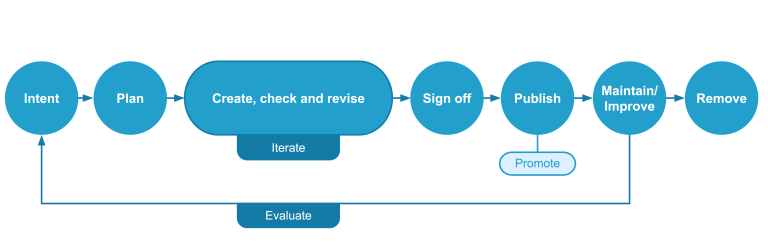
Content lifecycle diagram showing the stages of content management from intent and planning through creation, review, approval, publication, maintenance and removal. Arrows connect each stage in sequence, with additional feedback loops for evaluation, iteration and promotion, illustrating that content is continuously reviewed and improved throughout its lifecycle.

The content lifecycle starts with Intent then moves through the following stages; Plan, Create, Sign off, Publish and Maintain/Improve. This process is circular because after content has been published and it is being maintained, it goes back to the start of the process to run through and improve it. In this way we build in continual improvement.

Why use the content lifecycle

Use the content lifecycle to get content published, keep it relevant and continuously focus on value for the user.

When you apply the right skills at every lifecycle stage, you ensure content quality and relevance and a channel- and audience- approach.

How to ensure content usability

Plan content

Plan to define the end-to-end content task so the broader team has clarity about user needs and business goals.
L&D Groups
Create user-centred content
L&D Categories
Content Strategy Guide
Was this page helpful?
Last updated
28 September 2026

Acknowledgement of Country

The APS Academy acknowledges the Traditional Custodians of Country throughout Australia and recognises the continuing connection to lands, waters and communities.
We pay our respect to Aboriginal and Torres Strait Islander cultures and to Elders both past and present.

Museum of Australian Democracy
Old Parliament House 
Parkes 2600

APSLearn terms & conditions

About us

apsacademy@apsc.gov.auContact us
ABN: 99 470 863 260 
  • LinkedIn - external site - external site - external site

Help us improve

We are always looking for ways to improve the user experience of our website

 Share your thoughts

  • © 2021 APS Academy. All rights reserved.
  • FOI
  • Privacy Policy 
  • Terms of use
  • Accessibility
Back to top