





Social Learning in Remote Workplaces
A manager of a hybrid team can use this resource to design virtual peer‑learning sessions and online communities of practice, so knowledge sharing continues effectively across locations and time zones.
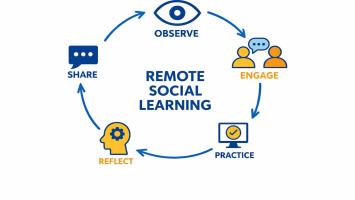
Social learning in remote work
Social learning is the way people pick up ‘know-how’ (knowledge, skills, behaviours and experience) by:
- observing others
- interacting with and modelling others
- co-creating
- sharing what works.
In a traditional office environment, social learning happens naturally. This can be through:
- information sharing conversations
- hallway conversations
- questions
- shared lunch discussions
- meetings
- brainstorming
- observing leaders and peers.
All foster a culture of knowledge exchange and informal mentorship. When teams and groups work remotely, the informal learning that usually happens naturally (like quick chats in the hallway) needs to be intentionally designed. Clear rituals, tools and norms can form part of that design to create opportunities for people to learn from each other.
Why social learning is important in remote work
Working remotely means fewer casual conversations, which can make it harder to share information and knowledge. Social learning is just as important in remote work as it is in the traditional office environment. Effective social learning:
- improves skill development
- strengthens team culture
- increases engagement
- speeds up on-boarding
- reduces isolation
- improves knowledge retention.
Without social learning, remote employees may feel disconnected and find it harder to absorb unspoken knowledge. It is important to find fit-for-purpose ways to replicate traditional social learning in a flexible work environment.
Benefits
- Reduces isolation and builds connection by enabling employees to learn from and with each other, strengthening relationships despite physical distance.
- Enhances knowledge sharing through peer discussions, mentoring, and collaborative problem‑solving that captures practical, experience‑based learning.
- Improves engagement and motivation by making learning more interactive, inclusive, and embedded in day‑to‑day work rather than learning purely in formal training.
- Accelerates capability development as employees learn in real time from diverse perspectives, supporting adaptability and continuous improvement in distributed teams.
Social learning ideas to support remote settings
Observe
- Record meetings and offer opportunities to reflect and embed information
- Screen sharing
- Shadowing via live video
Engage
- Shared digital workspaces
- Group projects and problem solving
- Moderated or casual discussion forums
- Create a system of user generated content e.g. share templates, lessons learnt
Practice
- Co-create work with others
- Contribute to shared documents
Reflection and feedback
- Peer reviews
- Virtual mentoring and coaching using an in-the-time-of-need model
- Regular check-ins
- Mentoring
Share and model
- Senior staff demonstrating workflows
- Leaders modelling varying communication styles to suit online audiences.
- Leverage micro-learning by offering bite-sized content that is relevant and easy to retain.
Best Practices for Encouraging Social Learning Remotely
Structure onboarding
- Provide environmental awareness and set expectations.
- Assign virtual buddies or mentors within one week.
- Schedule a shadow session, for example complete one micro-task with a peer.
- Build awareness of why continued communication is important
- Encourage self-directed learning.
Virtual Communities of Practice (CoP)
- Provide new starters information on the CoP charter, how to assess backlogs of topics and any shared content chats.
- Within COP’s rotate facilitators, problem solve and provide ways to engage with others on topics of interest.
Peer learning opportunities
- Pair programming, with rotating pairs and published goals.
- Cross-team projects with clear ‘learning objectives’.
Encourage knowledge sharing
- Show and tell meetings
- Recorded tutorials
- Open Q&A sessions where answers can be turned into a frequently asked questions document.
- Real-time access to corporate knowledge bases, with ‘How-To’ guidance and document owners clearly visible.
Leadership visibility
- The provision of scheduled communication updates (weekly, fortnightly, monthly).
- Regular team updates.
- Leaders can provide transparent roadmaps and ‘Ask Me Anything’ sessions
Challenges in remote social learning
Working remotely makes social learning more difficult because it thrives on casual, in-person interactions. The below table outlines the key challenges that can affect social learning in a remote work environment, along with practical strategies to address each challenge. By identifying challenges early, discussing these with your team and applying targeted solutions, we can create a more connected, engaged and effective remote social learning environment and support learning culture.
| Challenge | Strategies to Overcome |
|---|---|
| Lack of spontaneous interaction | Schedule regular check-ins, virtual coffee chats, and informal team discussions to encourage knowledge sharing. |
| Technical difficulties | Ensure team members have a robust connectivity, training in how platforms may interact to minimise lag and multiple avenues to access technical support. Be patient and provide additional time to complete tasks in unforeseen circumstances. |
| Time zone differences | Endeavour to synchronise at least one team meeting a fortnight that all can attend. Provide a recording, summary and action list from meetings. Rotate meeting times. |
| Digital fatigue | Keep meetings succinct, schedule breaks during longer online meetings and encourage staff to move away from the screens once an hour. Camera’s optional. Cap scheduled video to 4 hours a day to risk manage. |
| Reduced non-verbal cues | Communicate clearly, encourage questions and use video calls when tone, context and body language is important. Promote structured turn taking in meetings, use digital reactions and chat cues. Invite written contribution before/after meetings |
| Isolation and disengagement | Create team-building activities and social time, mentorship opportunities and recognise achievements to strengthen connection and engagement. |