

How mentoring supports a learning culture
An organisation can establish an internal mentoring program using this resource to support knowledge transfer, career development and cultural learning between experienced employees and those newer to the APS.
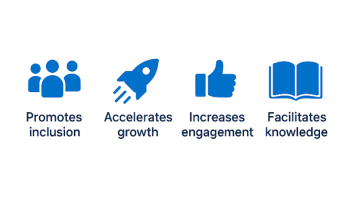
The mentoring role in developing a learning culture
This resource outlines how informal and formal mentoring help build a strong learning culture in the Australian Public Service (APS). This type of mentoring supports capability, stewardship, integrity and the Australian community.
How mentoring supports a learning culture
A strong learning culture is essential for an effective APS because it:
- strengthens stewardship of public resources
- builds capability to operate in complex, high scrutiny environments
- supports policy continuity and corporate knowledge
- enables adaptability in response to government priorities
- develops confident, ethical and accountable work practices
- promotes recruitment and retention.
Mentoring supports these outcomes by:
- transferring knowledge about how government operates
- building people’s judgement, not just technical competence
- reinforcing APS Values and the APS Code of Conduct
- normalising reflection, feedback and continuous improvement
- supporting interpretation of newly acquired skills into operational context
- supporting leadership development and readiness
- increasing professional networks
- improving inclusion and retention benefits.
A mature APS learning culture intentionally supports:
- informal mentoring (embedded in daily work)
- formal mentoring (structured and equitable).
Benefits of mentoring
- Encourages knowledge sharing: Mentoring creates opportunities for experienced individuals to pass on skills, insights and best practices.
- Builds confidence in learners: Support and guidance from a mentor helps individuals feel more capable and willing to take on challenges.
- Promotes continuous development: Ongoing feedback and support encourage a mindset of lifelong learning and improvement.
- Fosters strong relationships and collaboration: Mentoring strengthens connections within teams, helping create a supportive and positive learning environment.
Informal mentoring in the APS
Informal mentoring is when learning happens naturally through work interactions, conversations, observation and reflection. It is not formally labelled as mentoring. Informal mentoring is a key component of social learning
APS specific examples
Policy development and advice
- A director explains how to frame advice neutrally for government while clearly outlining risks and options.
- A senior officer debriefs a government brief, explaining why certain issues were escalated.
- A team discusses how consultation feedback influenced final policy advice.
Program delivery and operations
- An experienced staff member explains how they apply discretion within program guidelines.
- A manager talks through how delivery impacts policy intent, helping staff understand the end to end system.
- A team leader models how to manage competing deadlines during peak demand periods.
Governance, risk and integrity
- An SES Band 1 explains lessons learned from an Australian National Audit Office audit or internal assurance review.
- A finance or procurement specialist shares how probity considerations shaped a decision.
- A colleague discusses how APS Values guided them through an ethical dilemma.
How informal mentoring builds APS capability
| Informal practice | APS Value Capability strenghthened |
|---|---|
| Explaining decision-making | Accountability, integrity |
| Sharing lessons from audits or reviews | Stewardship |
| Encouraging questions | Psychological safety |
| Making tacit knowledge visible | Professional expertise |
| Reflecting on outcomes | Continuous improvement |
Role of APS leaders in enabling informal mentoring
APS leaders foster informal mentoring by:
- making their thinking visible, especially in high stakes contexts
- debriefing policy, program and governance processes
- modelling curiosity, humility and reflective practice
- creating time for learning conversations, not only status updates
- encouraging staff to observe:
- Senate estimates
- interdepartmental committees
- ministerial briefings (where appropriate).
Example
After a Senate estimates process, an SES leader holds a short team debrief and asks:
• What insights emerged?
• What worked well in our preparation?
• What capability gaps did we notice?
|
Example |
|---|
|
After a Senate estimates process, an SES leader holds a short team debrief and asks:
|
Challenges
Informal mentoring relies heavily on existing networks. Some employees who are less connected may not have equal access to informal mentoring opportunities.
Further information can be found in the fact sheet ‘Social learning in remote workplaces’
Formal mentoring in the APS
Formal mentoring is a structured, planned development relationship aligned with APS capability needs and workforce priorities.
Common APS applications
Graduate and early career mentoring
- Graduates are paired with experienced APS officers.
- The focus areas include:
- navigating Commonwealth systems
- APS Values and APS Code of Conduct
- effective policy and service delivery practices.
Leadership pathway mentoring
- Executive level (EL) staff are mentored by SES officers.
- The capability focus is:
- strategic thinking
- leading in ambiguity
- stewardship and system leadership
- working with ministers and central agencies.
Role transition mentoring
- New managers are supported through their first 6 to 12 months.
- Staff transition between:
- policy and delivery roles
- line agencies and central agencies
- specialist and leadership roles.
Cross portfolio and reverse mentoring
- Staff are mentored across agencies to reduce silos.
- Reverse mentoring is used (for example, digital, lived experience, service delivery perspectives).
- The capability focus is:
- APS wide capability building
- collaboration across agencies.
What good formal mentoring looks like in the APS
| Element | APS application |
|---|---|
| Clear purpose | Linked to APS Capability Frameworks |
| Defined boundaries | Developmental, not performance management |
| Time-bound | Usually 6 to 12 months with commitment from the mentor, mentee and line supervisors |
| Supported mentors | Guidance on ethics, inclusion and power dynamics |
| Reflective | Focus on judgement, learning and application |
Informal vs formal mentoring
| Informal mentoring | Formal mentoring |
|---|---|
| Embedded in daily APS work | Structured programs |
| Happens through conversations and observation | Scheduled mentoring sessions |
| Often manager-to-staff or peer-to-peer | May sit outside reporting lines |
| Continuous | Time-limited and reviewed |
| Spontaneous | Matched mentor-mentee pairs |
| Builds day-to-day judgement | Builds longer-term capability |
High performing APS agencies intentionally support both.
Practical actions to strengthen mentoring
For agencies
- Design mentoring with a clear purpose
- Ensure mentoring is planned so people can learn and share knowledge and build regular check-ins into training.
- Make roles clear, provide a mentor–mentee charter and give people training boundaries.
- In formal mentoring, match mentors and mentees in ways that are fair and transparent and give everyone a chance to take part.
- Track and evaluate formal mentoring outcomes by looking at how people’s behaviour changes.
For SES and EL leaders
- Embed learning questions in meetings:
- Use kick-start questions like ‘What’s on your mind?’ to initiate focused conversations.
- Use the AWE (‘and what else’) question to shape 2-way conversation and mindfulness.
- Ask, ‘What’s the real challenge here?’ to help uncover deeper issues.
- Finish by asking, ‘What is the most useful for you?’ to ensure there is a lesson learnt from the meeting.
(Reference: Adapted from the Art of Mentoring: Mentor Quick Guide, 2025)
- Encourage shadowing and short rotations.
- Recognise mentoring behaviours in performance discussions.
- Actively participate and model mentoring behaviours themselves.
- Provide mentors with training and support.
- Acknowledge mentoring in workload planning.
For mentors
- Link learning to APS Values including stewardship.
- Share stories of trade offs and ethical judgement.
- Focus on systems and context, not just tasks.
- Encourage reflection and self directed learning.
For staff and mentees
- Seek insight and feedback proactively.
- Ask about context, history and intent.
- Reflect on learning after key experiences.
- Share learning across teams and portfolios.
Key messages
- Mentoring strengthens stewardship, builds capability, and sustains a high performing APS.
- Incidental mentoring embeds learning into everyday work.
- Formal mentoring ensures equitable access to development.
- Learning cultures enable an adaptable, high performing APS.
- Everyone-regardless of role or level contributes to capability uplift.