

By the Place Based Policy team, Department of Social Services
Stronger partnerships are at the heart of successful government initiatives. Whether working with communities, First Nations organisations, service providers, businesses, philanthropy or other levels of government, APS employees rely on effective collaboration to understand local priorities and achieve meaningful outcomes.
While every partnership is different, experience from place-based initiatives across Australia highlight several common lessons. Strong relationships matter. Trust takes time to build. Local knowledge is valuable. Shared decision-making strengthens outcomes. Data and evidence help communities and governments to develop a shared understanding of local priorities and progress.
These lessons are not limited to specific programs or locations. They are relevant across policy, program design, service delivery and evaluation.
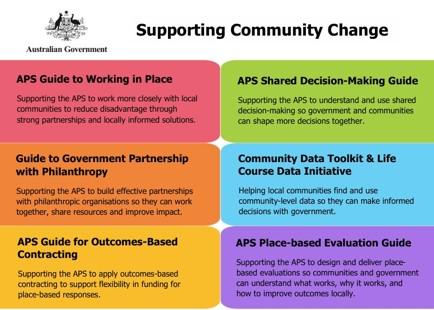
To support this work, the Department of Social Services has developed the Supporting Community Change resources. These resources provide consistent and practical guidance for place-based and community-led engagement, partnerships, decision-making and learning. The resources establish a common language and shared approaches to working alongside communities and partners.
The APS Guide to Working in Place supports APS employees to understand place-based practice and apply practical approaches for working with communities. The guide identifies seven ways of working in place, including coordination across government, collaborating across sectors, empowering local people, enabling shared decision-making and learning from experience.
The APS Shared Decision-Making Guide builds on these foundations by providing practical guidance on involving communities and partners in decisions that affect them. It explores how six principles, including shared intent, mutual responsibility, two-way learning and adaptability support effective partnerships and better decision-making.
The APS Place-based Evaluation Guide supports APS employees to evaluate place-based work in ways that reflect the unique characteristics of community-led approaches. The guide emphasises early engagement, collaborative learning, capability building and continuous improvement, helping practitioners generate and use evidence to strengthen outcomes for communities over time.
Partnerships often extend beyond government and community. The Guide to Government Partnership with Philanthropy explores how governments and philanthropic organisations can work together through shared purpose, collaboration and learning to address complex social challenges and create positive outcomes for communities.
Evidence plays an important role in effective partnership. The Community Data Toolkit helps users find, understand and use community-level data to support local decision-making. It helps build a shared understanding of local conditions, identify priorities, track change over time and strengthen relationships between communities and governments.
This toolkit is complemented by the Life Course Data Initiative, which is creating an evidence base by bringing together cross-jurisdictional data from early childhood, health and community services. The initiative is helping generate insights to inform long-term responses to disadvantage while also supporting communities to access, interpret and use data for local decision-making.
For those interested in innovative approaches to commissioning and funding, the Outcomes-Based Contracting Factsheet Series provides practical guidance on designing contracts around measurable outcomes rather than activities or outputs. The resource explores target cohorts, outcome measurement, pricing outcomes and readiness for outcomes-based contracting.
APS employees interested in strengthening these capabilities can explore them further through upcoming learning opportunities:
On 27 October 2026, the APS Academy and Australian Centre for Evaluation will host a MasterCraft Series event on Place-based Strategy. The session will share practical lessons on partnerships, community leadership and place-based action with insights from community leaders in the place-based sector.
Building strong partnerships is critical when engaging First Nations communities. Effective engagement requires approaches grounded in respect, relationships, cultural capability and shared decision-making. These principles are reflected throughout the Supporting Community Change resources and align with broader efforts to strengthen partnerships with First Nations communities.
APS employees can continue building engagement capability through the facilitated workshop on Engaging First Nations Communities, available through APSLearn.
Partnership capability is not confined to a single role, profession or agency. It is a practical capability that helps the APS work effectively alongside communities and partners. The Supporting Community Change resources and associated learning opportunities provide practical tools to help APS employees strengthen this capability and contribute to lasting community change.