

MasterCraft Series - What makes place-based evaluation different?

This panel discussion and Q&A will provide a lively and thought-provoking discussion about the differences between traditional program evaluation and place-based evaluation, with panel members sharing their experience and examples from different organisational perspectives across the field.
Evaluation in a place-based context must be fit-for-purpose – this requires deep consideration of the relational aspects that underpin place-based work, knowledge and understanding about the places and communities involved, and different leadership and governance structures to support decision-making.
This panel discussion will focus on exploring place-based evaluation from multiple perspectives, including hearing views from:
- whole-of-government
- commissioned evaluator
- community representatives leading place-based work in Australia
The presenters will discuss the unique opportunities and challenges involved in evaluating place-based work, drawing on the experience of monitoring, evaluation and learning processes in different place-based projects.
Panellists
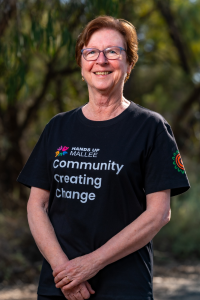
Fiona Merlin
Fiona Merlin has been with Hands Up Mallee since its inception in 2015. She brings extensive leadership experience from her career in education, including serving as principal of two schools and as a Principal Consultant for the merger of four schools to form Merbein P-10 College. Fiona is passionate about learning and improvement. She leads the development and implementation of HUM’s Measurement, Evaluation and Learning (MEL) Framework, supporting the organisation to use evidence and reflection to inform decisions and be accountable to the community. Fiona’s commitment to genuine evaluation and shared learning is central to HUM’s long-term impact.

Gary Field
Gary Field is a proud Wiradjuri man and the National Coordinator at Empowered Communities Limited. He works alongside Empowered Communities regions across Australia, supporting community-led partnerships that strengthen local decision-making, drive systems reform, and improve outcomes for Aboriginal and Torres Strait Islander peoples. Gary is a founding member of Gilibanga, a First Nations-led movement dedicated to centring Indigenous voices in impact measurement while advancing systems reform and cultural capability across the evaluation sector. He also served on the First Nations Advisory Group that helped shape the Australian Public Service Framework for Governance of Indigenous Data. Gary holds a Master of Public Health (Indigenous Health) and a degree in Social Sciences. His work is grounded in a strong commitment to Indigenous data sovereignty, community governance, and place-based approaches that enable communities to lead the design, delivery, and evaluation of the policies and services that affect them.

Suzanne Butler
Suzanne Butler leads a team in the Australian Centre for Evaluation responsible for embedding good evaluation principles and practices across the government. Suzanne has over 20 years of experience managing whole-of-government public sector reforms in the Australian Government. Most recently, Suzanne led the design and implementation of the Commonwealth Evaluation Policy and Toolkit. She specialises in strategic policy and change management and has extensive experience advising on federal budgets, particularly in relation to health and social policy. Suzanne has expertise in the Commonwealth resource management, performance, and budget frameworks. In previous roles at the Department of Finance, she led strategic policy reviews in the areas of health, aged care, veterans’ affairs, and service delivery reform. Suzanne has qualifications in psychology, political science, management, and business administration.
Jessica Smart
Jessica Smart is a Senior Research Manager and leads the evaluation function at the Australian Institute of Family Studies. Jess has been at the Australian Institute of Family Studies since 2016, undertaking research and evaluation that supports governments and non-government organisations to strengthen policy and social service delivery for Australian families and communities. Jess has qualifications in social science and humanities, public health, and community development and is particularly interested in participatory and engaged research approaches and capability building.
Facilitator
Lorraine Heywood, Treasury
Participant benefits
- Gain practical insights into how place-based evaluation differs from traditional approaches, including methods for measuring impact and supporting continuous learning.
- Learn from government, evaluator and community perspectives, helping build a more holistic understanding of effective place-based practice.
- Strengthen your evaluation capability through real-world examples, lessons learned and strategies for working effectively with diverse communities and stakeholders.
Suitable for
All Staff
Face-to-screen considerations
- Prior to the session start date, it is suggested that you check if your agency’s network has any restrictions using any virtual classroom platform. If you are unable to access the virtual classroom platform on your work device or network, you will need to use a personal device.
- Please ensure you have access to a working camera and microphone to participate.
Attendance (Virtual)
When you attend a virtual session:
- Provide your name or email when joining, as our attendance reports record this information from the virtual classroom platform.
- If you log into the session with a different email address to the one you are registered with, let us know to ensure your attendance is properly credited.
- If you join as a group from one location or cannot provide your details during the session, please email us afterwards so we capture your attendance.
- If we do not receive your information, you may receive a notice indicating you were not marked as attended.
* Capacity limits may apply. Please log into APSLearn to check availability.
- If the session is full or none of the additional sessions are suitable, you can express your interest, through APSLearn, for this event. You will be added to a mailing list to be notified when a new session becomes available.