


Skip to main content Skip to main navigation
Australian Public Service Academy Australian Public Service Academy Australian Public Service Academy Australian Public Service Academy logo

APSLearn logo

APSLearn Login

APS Professions logo
Professions MCP Portal

Main navigation

  • APS Craft

    APS Craft

    • Integrity
    • Working in Government
    • Engagement & Partnership
    • Implementation & Services
    • Strategy, Policy & Evaluation
    • Leadership & Management
  • APS Professions

    APS Professions

    • Complex Project Management Profession
    • Data Profession
    • Digital Profession
    • Evaluation Profession
    • HR Profession
    • Procurement and Contract Management Profession
  • APS People

    APS People

    • Diversity and Inclusion
    • Health and Wellbeing
    • Work Health and Safety
    • Your APS Career
  • APS Induction
  • Learning Experiences

    Learning Experiences

    • Courses
    • Course session dates
    • Microcredentials
    • Events
    • Resources
    • Cross Agency Training Hub
    • Nationwide course sessions
    • SES Executive Coaching
  • Our Services

    Our Services

    • APSLearn
    • APS Academy course offerings
    • APS Academy Training Venues
    • Onboard learning experiences
    • Share and reuse learning experiences
  • Guides

    Guides

    • APS L&D Good Practice Guide
    • Content Strategy Guide
  • News

    News

    • Academy News
    • MyAcademy
  • About us

    About us

    • About the APS Professions
    • Faculty
    • Learning approach
    • Contact
    • Supplier FAQ's

Journey maps

You are here

  1. Home
  2. Learning Experiences
  3. Resources
  4. Journey maps
  • Linkedin
  • Twitter
  • Facebook
  • Email
Print

Why create a journey map?

Journey maps are useful in the early stage of research and discovery. Use your journey map to step out what you have learned about the user during your research.

Prep time People Run time
2 hours 2 to10 2 hours to 1 day

Preparation

Materials

To create a successful journey map, try not to assume or guess people’s real-life experiences prior to the exercise.
  • whiteboard or butcher’s paper
  • markers
  • post-it notes

How to make a journey map

Step 1: Decide on your user

You need to define the user in your story. You should do this by using evidence from user research, so the journey is realistic. For example, what they were trying to do, their motivations, and their context before and after the interaction? Do this in every iteration of development.

Quantitative research is good, but you really need qualitative research. It will give you the insights to how users think and feel through their journey.

Step 2: Choose the scenario

Define the scope of the experience you are going to map.

For example, this could be a new cafe registering their business. Try to keep your user journey simple. Your map may cover the journey from the initial business plan through to registration and opening the business.

Make sure you define a clear goal for the user. For the example above, the goal would be to register a business.

Step 3: Visualise the journey


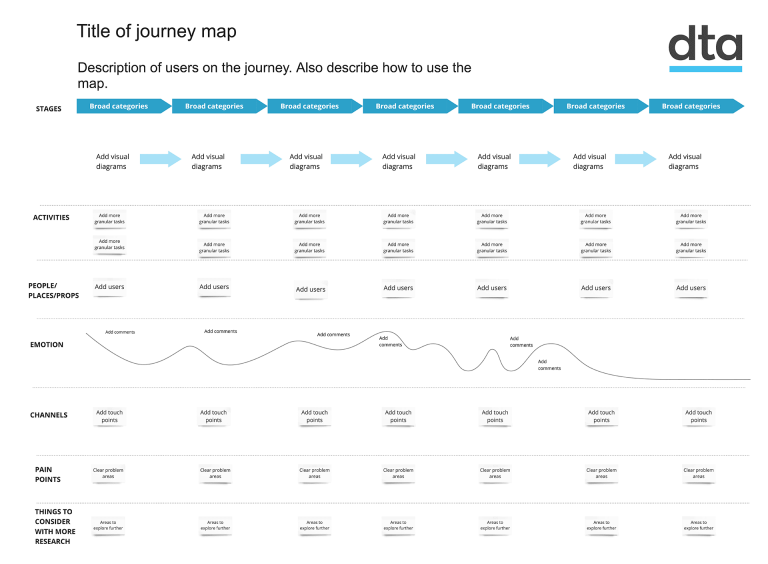
You can map your user’s journey in a way that suits your team. It doesn’t need to be a linear timeline. Represent the user’s journey in swimlanes. Use visuals to communicate points on your journey. Use post-it notes on a wall or a marker on butcher’s paper to show:

  • your user — describe their age, background, thoughts, feelings, opinions, expectations and pain points
  • timeline — define the scope of the user’s journey in their context
  • touchpoints — how users interact with your agency and various levels of government, at different points in the journey
  • emotions — how the user feels in the journey
  • channels — how they are interacting with your agency (this could include website, mobile app, call centre or shopfront)
Customer journey map template from the Digital Transformation Agency (DTA). The diagram shows a series of stages across a user journey, with sections for activities, people, places and props, emotions, channels, pain points, and areas requiring further research. The template is designed to help teams map and understand user experiences, interactions and challenges across a process or service.

Visualisation to help understand the journey of a user trying to complete a task on a website.

Follow up

Display your journey map in a prominent spot so your team and stakeholders can view it.

Walk stakeholders through the journey. By sharing this the journey, you encourage empathy for your users. Your stakeholders will also gain an understanding of the challenges they face.

Keep updating your map. It’s a living artefact.

You can use your journey map to define scope and show where to solve problems. You can also use it to break down business area silos across a service. This will help to better understand the whole user experience.

Highlighting user pain points along a user journey is a crucial part of understanding the problem. These pain points can help you write user stories.

L&D Groups
Research and analyse
L&D Categories
Content Strategy Guide
Was this page helpful?
Last updated
24 September 2026

Links & Downloads

The following sources will help you create a user journey map:
UX Mastery: ‘How to create a customer journey map’
GOV.UK: ‘How to create a user journey map’

Acknowledgement of Country

The APS Academy acknowledges the Traditional Custodians of Country throughout Australia and recognises the continuing connection to lands, waters and communities.
We pay our respect to Aboriginal and Torres Strait Islander cultures and to Elders both past and present.

Museum of Australian Democracy
Old Parliament House 
Parkes 2600

APSLearn terms & conditions

About us

apsacademy@apsc.gov.auContact us
ABN: 99 470 863 260 
  • LinkedIn - external site - external site - external site

Help us improve

We are always looking for ways to improve the user experience of our website

 Share your thoughts

  • © 2021 APS Academy. All rights reserved.
  • FOI
  • Privacy Policy 
  • Terms of use
  • Accessibility
Back to top