

Leading change to foster a learning culture
A practical guide for leaders and teams to embed sustainable learning practices.
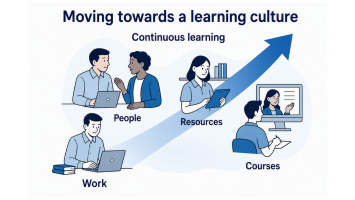
Learning culture and how to enable it
A learning culture is a work environment where employees continuously build skills, share knowledge, reflect on experience and improve performance as part of everyday work.
A strong learning culture means:
- We learn every day, from our work, from each other, and from challenges. Learning is not a one off event — it’s embedded in workflows, reflections, debriefs, and collaboration.
- We all share responsibility for learning.
- Individuals drive their own development.
- Managers create space, time, and safe environments for learning.
- Leaders set expectations and enable investment in capability.
- Learning is accessible to everyone, anywhere, anytime. Technology and digital platforms support equal access to high quality learning.
- Learning aligns to organisational strategy and demonstrates impact. Learning is a mechanism to achieve business priorities — not an optional add on.
- Learning initiatives are inclusive and designed around user needs. Content is practical, timely, relevant, and tailored to diverse learners.
- The APS creates efficiency with scalable, reusable learning solutions. We avoid duplication, share expertise, and build common capability resources.
The APS Change Framework highlights that successful change requires:
- Clear vision
- Leadership engagement
- People centred design
- Aligned systems and governance
- Ongoing monitoring and reinforcement
Using these principles, a learning culture becomes a strategic change initiative, not an isolated Human Resources/Learning and Development team activity.
Why learning culture is important
When we position developing a learning culture as a change initiative it lets us adapt, innovate and keep performing well as things around us change.
Benefits
- Improves adaptability by helping individuals and teams respond effectively to change and emerging challenges.
- Enhances performance through continuous skill development and knowledge sharing.
- Strengthens engagement by fostering an environment that values curiosity, growth and learning.
- Supports the organisation to succeed over time by making learning part of everyday work and decision‑making.
The case for change
| Problem | Impact | Learning Culture Solution |
|---|---|---|
| Training is ad hoc and reactive | Low capability uplift | Structured, ongoing learning cycles |
| Learning varies across business areas | Inconsistent practice | Shared frameworks and expectations |
| Leadership support fluctuates | Low uptake & engagement | Clear roles for leaders in learning Increased uptake and capability uplift |
| Budget is spent on courses, not capability outcomes | Poor ROI. Measure attendance, not capability uplift. | Focus on impact, not attendance |
A learning culture in practice
Leaders
- Model learning behaviours: reflection, coaching, and knowledge sharing
- Allocate time and resources for learning
- Learning goals are planned in Employee Performance Management conversations
- Regularly discuss development in team meetings and 1:1s
- Recognise and reward learning effort and application
Teams
- Share insights after projects or training
- Participate in peer learning, shadowing, and collaborative problem‑solving
- Use learning plans aligned to performance goals
- Apply continuous improvement principles
Systems & Processes
- Learning embedded in workforce plans, role descriptions, and onboarding
- Clear governance over capability uplift priorities
- Access to digital learning, on‑the‑job learning, and communities of practice
- Regular measurement of learning outcomes
Practical change actions for teams, supervisors, managers and leaders
The following actions show how to embed a learning culture. They align to change management good practice (based on the Prosci ADKAR® model). The letters in ADKAR stand for awareness, desire, knowledge, ability and reinforcement.
Clarify the vision (raise awareness)
People need to understand why learning matters for your business area before they will engage with how to do it.
- Talk with the team about what would look different in a learning culture.
- Link learning to their performance discussions, service delivery, risk management, reform agendas, mobility or policy outcomes.
- Share stories or data on gaps current practices create and on how continuous learning benefits the team, the agency and individuals.
- Discuss the risk of not changing to a learning culture.
Create desire to participate in the change and support the shift to a learning culture
Awareness does not automatically lead to willingness. Desire grows when people see how the change is relevant to them and when they feel supported.
- Help individuals understand what they can personally gain – for example, mobility, career progression, increased confidence and increased capability.
- Managers communicate how a learning culture strengthens team performance.
- Link the change to driving organisational and business area outcomes.
- Celebrate learning stories and when people apply new skills.
- Identify early adopters as change champions who share their experiences.
- Reduce barriers such as workload and permission.
- Ensure psychological safety.
Provide knowledge and skills to empower people to learn
Give people the knowledge and skills to operate within a learning culture.
- Staff know how to learn through work, people, resources and courses. Provide guidance on how to:
- create a learning plan
- run reflective practice sessions
- coach and give feedback
- integrate learning into project cycles
- Ensure managers know how to hold learning conversations, coach and embed learning into workflows. For example, have 10-minute stand-up learning conversations, or everyday learning activities for the team.
- Leaders are clear on how to sponsor and model continuous learning.
- Staff have access to agency learning frameworks and relevant courses.
Track and measure ability
Let people demonstrate the new behaviours. Knowledge does not guarantee ability. People develop ability through practice, feedback and experience.
- Monitor participation, behaviour change and capability uplift.
- Staff regularly use on the job learning methods (for example, job shadowing, stretch tasks, reflections).
- Managers consistently build learning into work design. For example, integrate learning into workflow planning.
- Integrate learning goals into performance conversations. For example, learning opportunities are identified daily work tasks, as well as formal training.
- Provide coaching and mentoring networks.
- Ask ‘What did we learn?’ after meetings or projects.
- Embed learning discussions or debriefs into team meetings, newsletters or stand-ups.
Reinforce new behaviours
Reinforce the change so that the learning culture sticks. People need to see the change recognised and supported over time for the change to be sustainable.
- Leaders ask for learning outcomes, not training attendance reports in team meetings.
- Teams celebrate improvements or innovations that came from learning. Share stories of applied learning that created value or changed behaviour or process.
- Policies, systems and governance support (not obstruct) continuous learning. For example, build continuous learning expectations into role descriptions and performance conversations.
- Measures show learning impact on performance and business priorities.
- Align recognition processes with learning efforts and results.
- Maintain communities of practice to share and sustain capability.
Skills that support a learning culture during a period of change
To support a strong learning culture during periods of change, managers and leaders will use skills that support how people think, relate, adapt and sustain effort.
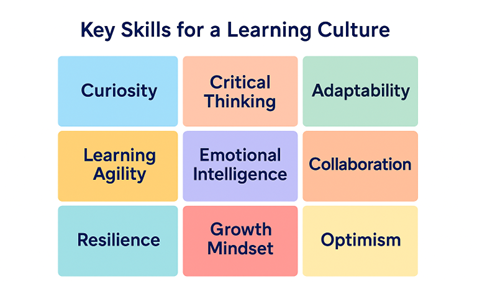
Curiosity
- Asks questions to understand new initiatives and changes
- Seeks diverse perspectives before forming conclusions
- Explores improvements beyond immediate role requirements
Why it matters: Change creates uncertainty for people – new problems, unfamiliar information and evolving expectations. Curiosity reframes uncertainty into opportunity by encouraging people to explore, ask better questions, and turn uncertainty into constructive learning and improvement.
Critical thinking
- Evaluates information using evidence and data
- Identifies risks, assumptions and implications of change
- Questions assumptions
Why it matters: During change there is often a large amount of information. Critical thinking helps people prioritise what matters, make informed choices about where to focus their development, and engage in learning in a purposeful and considered way.
Adaptability
- Modifies work practices in response to changing priorities
- Remains effective when processes or roles change
- Responds constructively to ambiguity
Why it matters: Change requires people to adjust how they work, not just what they know. Adaptability supports learning through action, enabling people to test new approaches, respond to feedback, and refine what they do as conditions and priorities shift.
Learning agility
- Quickly applies new knowledge to work activities
- Adjusts approach based on feedback and reflection
- Transfers learning across different contexts and challenges
Why it matters: Change is rarely a one-off event and rarely happens in isolation. Learning agility helps people continuously acquire, apply, and adapt knowledge to keep pace with evolving roles, systems and expectations.
Emotional intelligence
- Recognises own emotional responses to change and manages them effectively
- Demonstrates empathy and understanding when others experience uncertainty or stress
- Responds calmly and constructively to pressure or ambiguity
- Adjusts communication style to support different needs and perspectives
- Contributes to a psychologically safe environment that supports learning and open dialogue
Why it matters: Change can create uncertainty and people under pressure can have strong emotional responses. Emotional intelligence helps people manage themselves and support others. It creates the psychological safety needed for reflection, experimentation and meaningful learning.
Collaboration and knowledge sharing
- Shares insights and lessons learned with others
- Participates in cross-team learning activities
- Supports peers through change and skill development
Why it matters: One person does not hold all the answers during times of change. When teams collaborate and share knowledge, it allows collective learning opportunities, reduces duplication of effort and accelerates capability uplift across teams. When people have a shared understanding, a learning and development culture can be implemented more consistently.
Resilience
- Recovers from setbacks and maintains focus on learning objectives
- Sustains effort and engagement during prolonged uncertainty
- Manages workload and priorities to remain effective under pressure
Why it matters: Change is often uncomfortable. When managers and team leaders are resilient, staff continue to engage. This allows people to recover from setbacks, maintain momentum and identify opportunities for learning. They identify opportunities from experience rather than disengaging when progress is slow.
Growth mindset
- Views mistakes and setbacks as opportunities to learn and improve
- Seeks and applies feedback to strengthen capability
- Persists with learning when tasks are challenging or unfamiliar
Why it matters: Sustainable learning during change depends on seeing capability as something that can be developed; it is not fixed. A growth mindset encourages persistence, openness to feedback and confidence to learn through challenges. Change can become a catalyst to development rather than resistance.
(Realistic) Optimism
- Encourages others by recognising effort, milestones and learning gains
- Maintains motivation and constructive engagement during change initiatives
- Reinforces the value of learning as a pathway to improvement and adaptation
Why it matters: Sustained effort to change a culture requires the belief that improvement is possible. Realistic optimism helps people stay engaged and motivated through uncertainty by reinforcing the value of learning. It supports momentum towards longer-term change.
These skills in action for employees and leaders
| Leaders: role model and enable learning | Employees: actively engage in learning |
|---|---|
|
Leaders are expected to:
|
Employees are expected to:
|