





Assign accountability and ownership
When you govern content, you assign clear lines of accountability and ownership. This helps everyone involved to know who does what, according to their expertise.
Content teams |
|
|
Set up content teams with content leads as points of escalation. Doers and specialists apply their expertise to the content lifecycle stages. They create and deliver quality content. With clear lines of accountability, teams are better able to work together and to break down silos. Regular reporting on measures of success is part of content governance. Reporting helps to build trust and get long-term buy-in. You can imagine this model as a pyramid that displays the hierarchy of a content team from leaders to doers and specialists: Leaders:
Doers and specialists:
|
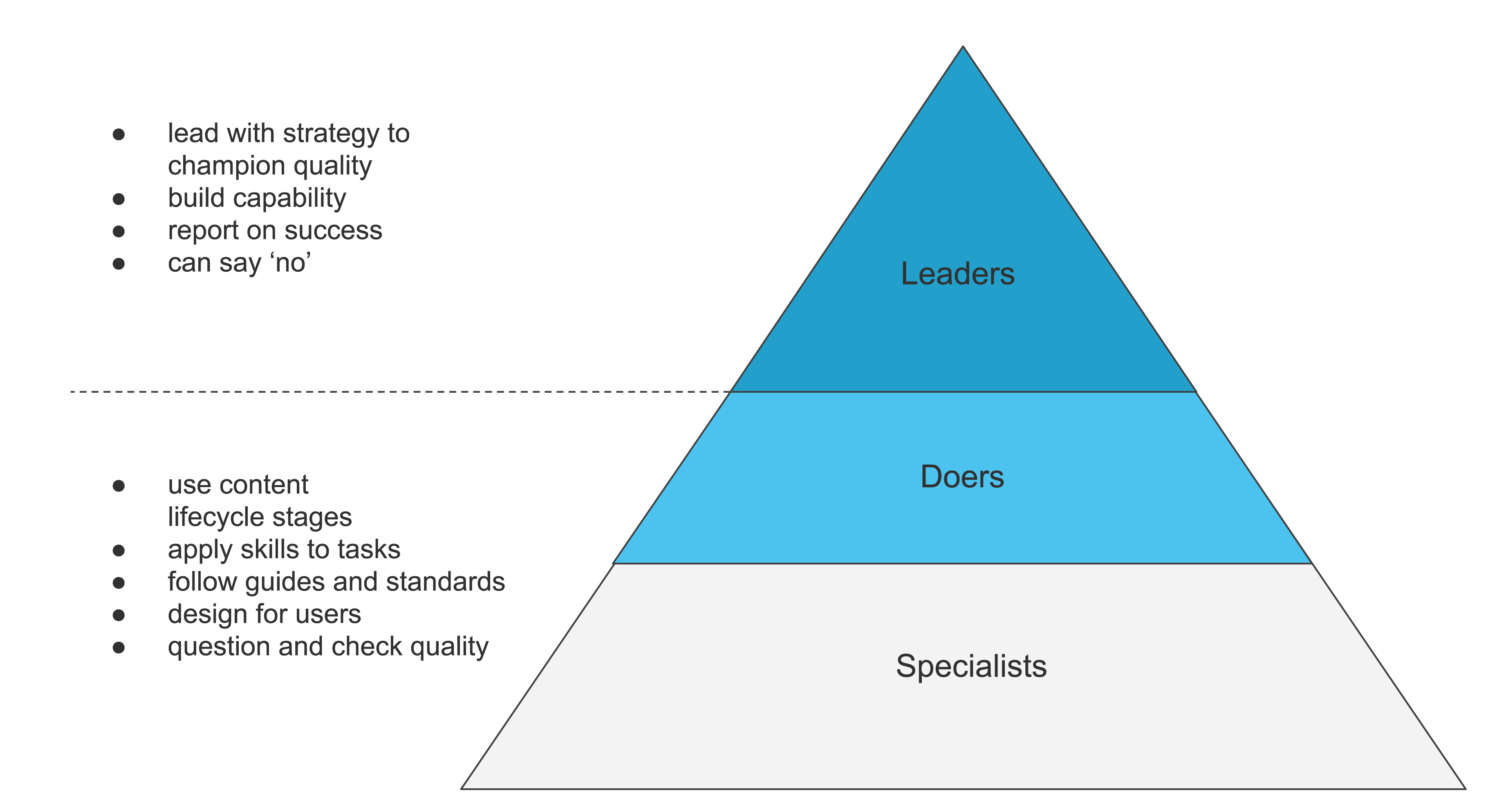
A pyramid that displays the hierarchy of a content team from leaders, to doers, then finally specialists. |
Leaders
Senior content lead/ content strategist/ communications manager
Appoint an overall content lead or strategist. As leaders they will raise the profile of quality content with senior executives and other teams.
The content lead reports to the digital governance committee on agreed measures of content success. Measures will be in line with the goals of your content strategy.
Terms of reference
- Scope: the size of your governance project
- Committee: the people on your committee and the types of content issues you will be responsible for
- Reporting: how and when you report to governance and what you will report
- Schedule: frequency of meetings and content governance report
- Business needs: your agency's business needs
- User needs: the needs of your users
Report and get buy-in
Reporting can help to get buy-in and build trust with agency leaders. This is where you can prove the value of content governance. Reporting should show how your content is progressing and what improvements you need to make it better.
Large scale projects
This includes things such as:
- budget and people
- reporting timeline on progress at regular intervals that the executive determine as appropriate
Accountability and ownership
To establish accountability and ownership, you'll need to:
- establish who owns a website’s content and strategy
- report on measures of content success
- set direction and mentor content creators
- act as a point of escalation. Can say ‘no’ to content that is not user focused
- set quality content standards, training, tools and templates
- champion the user experience
- champion content planning and workflow
- oversee content and information architecture
- educate people who request, provide, review and approve content.
- create communities of best practice
- be responsible for a maintenance plan
Doers
Subject experts, content leads and writers, web writing experts
The doers understand the stages of the business-as-usual (BAU) content lifecycle. They work together to source, create, check and publish quality content.
The subject expert or a web writing expert may source and write individually or share the writing. If pair writing, they will need to clarify and balance both business and user needs.
The doers must comply with endorsed guides and standards during this process. If they are unable to agree on the quality of content, ask the senior content lead to decide.
Accountability and ownership
- know the intended lifespan of the content
- understand how content fits in the information architecture (IA)
- know what related content is needed
- balance business needs and user needs
- review the quality of content
- direct users through the content
- ensure readability and accessibility
Specialists
Communications expert, subject expert, graphic designer, search strategist, web analyst, user researcher and information architect
Consult an external specialist or from within the agency. They must however, comply with endorsed guides and standards.
Accountability and ownership
- equip others with the information and expertise they need to create content
- consider user needs, including the user’s own search experience
- ensure branding is consistent
- recommend a social media strategy
- review content for factual accuracy and tone
- review and apply analytics
- synthesise analytics and usability testing results