





Design a workflow
Why design a workflow?
Workflow sets out clear interactions between people and tasks. This allows those involved to:
- know what they need to do and when to do it
- collaborate throughout the content production process
- track what stage content is at, who it's with and what's left to complete
- know who checks accuracy and quality and who manages revisions
| Prep time | People | Run time |
| 1 hour | 5 to 6 | 2 hours |
Preparation |
Materials |
|
You can either develop a single workflow for your agency or different workflows for distinct business functions. Consult with your team for feedback. Your outcome should be to have your future-state content workflow signed off. You may need to work on a few iterations before you reach that point. |
|
How to run a workflow activity
You may wish to improve the workflow of one business area. Invite people from the different stages of the content lifecycle stages.
Run a current-state discovery to help find out existing interactions and progress your content maturity. You are looking to improve on bottlenecks and to ensure quality checks.
Give your team an overview. You want to discover and visualise a clear and efficient way to work together during the content lifecycle.
Current-state workflow
Map out the stages of the content lifecycle across a wall or whiteboard. Use post-its or a marker to write headers of the stages.
Use the wall space to sketch out the flow of tasks between each stage. Ask your team to contribute by adding post-it notes under each of the lifecycle headings. Lead the group to:
- identify who the people are in each task
- allocate time frames for each task
- pay attention to your checks and revisions
- note guidelines and standards that you'll apply
- identify outputs for each stage
- note any blockers for a successful workflow and discuss how to improve.
Future-state workflow
Apply your current state findings to your new bespoke workflow. Start with what works well and progress to fix any blockers or improvements.
Your workflow should reduce complexity and increase efficiency. Allow time for checks (quality and accuracy) and revisions before sending for signoff. Signoff may be in a document or in CMS staging.
Prepare a users and roles sheet:
- add columns for: name, title, email
- add columns for business owner, manager, reviewer(checker), author, publisher
- use this as a guide to start on your diagram
Content production workflow |
|
|
Add each of the roles as vertical labels. Write up life cycle stages across the top of the workflow:
Draw up tasks for each role across the swimlanes under the relevant life cycle stages. Chart the interactions between roles. |
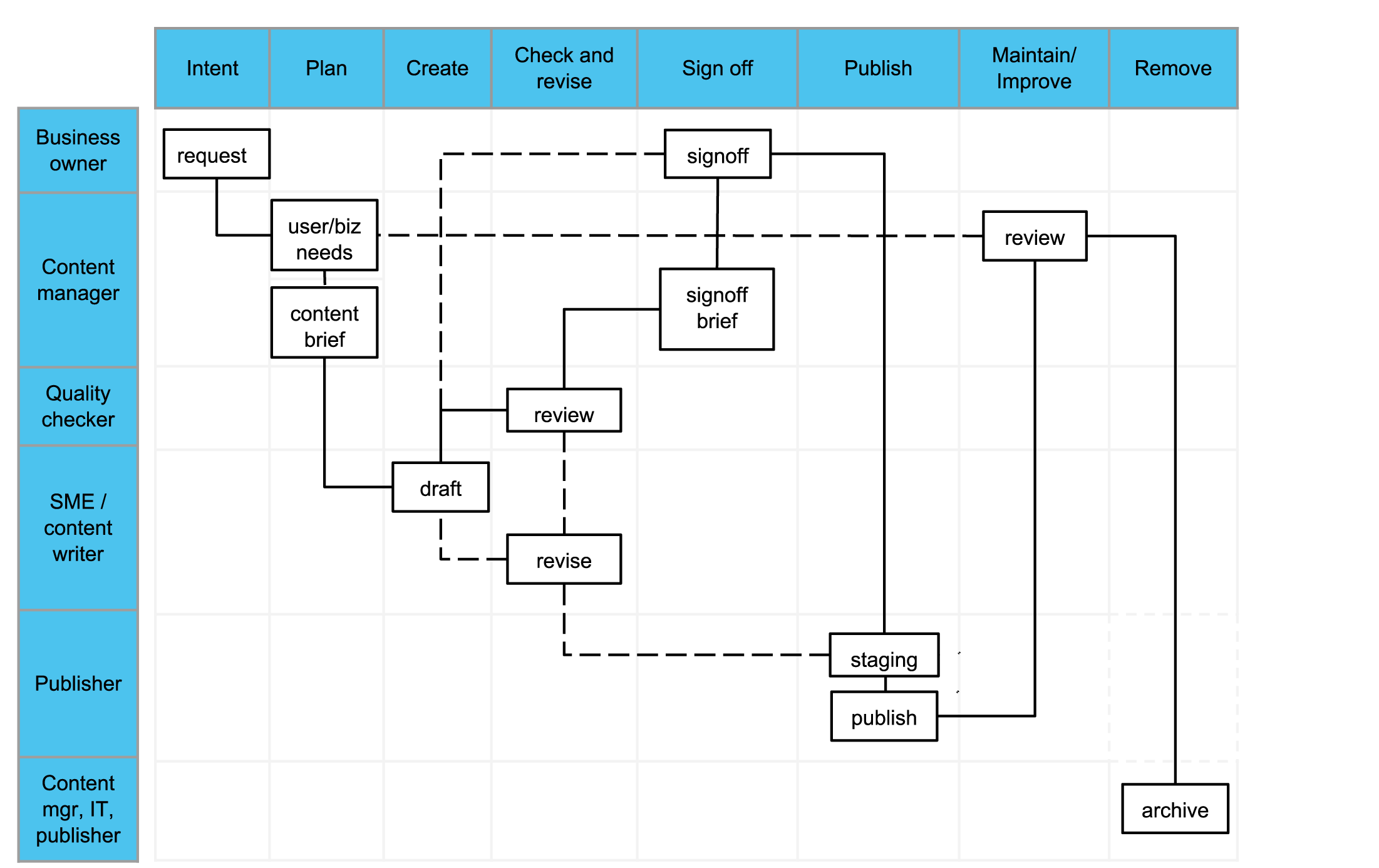
With your your content lifecycle and content roles in place, you can map out the tasks in your workflow. Tasks relate to who is doing them and at what stage in the lifecycle they happen. Each role aligns with a relevant task across the content lifecycle stages. The content production workflow also shows the interactions between tasks along the way. |
Having a signed-off workflow is essential for a successful content strategy
Follow up
Trial your draft workflow with your teams and keep them up to date on iterations. Make sure you sell the benefits of using a clear workflow.
Seek endorsement and sign off by the senior executive. Once agreed, publish the workflow on your intranet.
Continue to check in with teams to see how the well they are applying the workflow.