Skip to main content Skip to main navigation
Australian Public Service Academy Australian Public Service Academy Australian Public Service Academy Australian Public Service Academy logo

APSLearn logo

APSLearn Login

APS Professions logo
Professions MCP Portal

Main navigation

  • APS Craft

    APS Craft

    • Integrity
    • Working in Government
    • Engagement & Partnership
    • Implementation & Services
    • Strategy, Policy & Evaluation
    • Leadership & Management
  • APS Professions

    APS Professions

    • Complex Project Management Profession
    • Data Profession
    • Digital Profession
    • Evaluation Profession
    • HR Profession
    • Procurement and Contract Management Profession
  • APS People

    APS People

    • Diversity and Inclusion
    • Health and Wellbeing
    • Work Health and Safety
    • Your APS Career
  • APS Induction
  • Learning Experiences

    Learning Experiences

    • Courses
    • Course session dates
    • Microcredentials
    • Events
    • Resources
    • Cross Agency Training Hub
    • Nationwide course sessions
    • SES Executive Coaching
  • Our Services

    Our Services

    • APSLearn
    • APS Academy course offerings
    • APS Academy Training Venues
    • Onboard learning experiences
    • Share and reuse learning experiences
  • L&D Guide

    L&D Guide

    • Learning Design and Administration
    • Learning Culture
    • The Learner and Career Development
    • Learning Technologies
    • Evaluating Learning
    • L&D Search
  • News

    News

    • Academy News
    • MyAcademy
  • About us

    About us

    • About the APS Professions
    • Faculty
    • Learning approach
    • Contact
    • Supplier FAQ's

APS Professions capability model
An illustration of a whiteboard with 4 people gathered around it. Each person has a speech bubble above them with figurative dots representing speech.

You are here

  1. Home
  2. Learning Experiences
  3. Resources
  4. APS Professions capability model
  • Linkedin
  • Twitter
  • Facebook
  • Email
Print

We use a capability model to help explain the different skills, knowledge and personal attributes that combine to make up someone's overall capability.
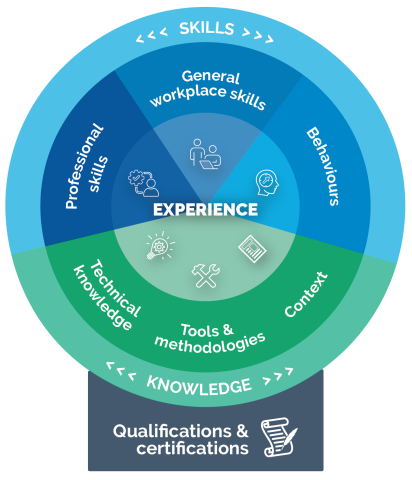
Diagram of a coloured wheel outlining skills and knowledge categories

Professional skills relate to someone competently performing activities in a specialist area of application to achieve organisational outcomes. Sometimes referred to as technical skills, these are skills that are only found in certain pockets of the workforce. Computer programming is an example of a professional skill.

General workplace skills relate to someone competently performing activities that are commonly performed across the workforce. Sometimes referred to as transferable skills, this includes what is often referred to as literacy and fluency skills. Minute taking is an example of a general workplace skill.

Behaviours relate to the personal abilities that someone expresses in the workplace. Sometimes referred to as attributes, social skills, interpersonal skills, soft skills, common skills, power skills etc. Communicating with influence is an example of a behavioural skill.

Experience is what someone gets when they apply their skills, knowledge and behaviours in the workplace to achieve a task or outcome, and through experience people can build their skills and knowledge. Producing a certain product for a high-profile customer would be an example of experience.

Knowledge relates to information that someone needs to possess to perform a skill competently. It may include methodologies, standards, history, context, and insights as well as facts. For the example of programming a computer, someone would need to know a programming language.

Qualifications and certifications are a mechanism for providing people with assurance that an individual has one or many of the aspects of capability described above.

Categories
Your APS Career
Was this page helpful?
Last updated
17 September 2026

Acknowledgement of Country

The APS Academy acknowledges the Traditional Custodians of Country throughout Australia and recognises the continuing connection to lands, waters and communities.
We pay our respect to Aboriginal and Torres Strait Islander cultures and to Elders both past and present.

Museum of Australian Democracy
Old Parliament House 
Parkes 2600

APSLearn terms & conditions

About us

apsacademy@apsc.gov.auContact us
ABN: 99 470 863 260 
  • LinkedIn - external site - external site - external site

Help us improve

We are always looking for ways to improve the user experience of our website

 Share your thoughts

  • © 2021 APS Academy. All rights reserved.
  • FOI
  • Privacy Policy 
  • Terms of use
  • Accessibility
Back to top