





By Pavi Singaravelu, AI Capability, APS Academy
On 12 August 2026, the APS Academy welcomed Professor Beth Simone Noveck for 2 engaging and successful events on AI, leadership and public engagement.
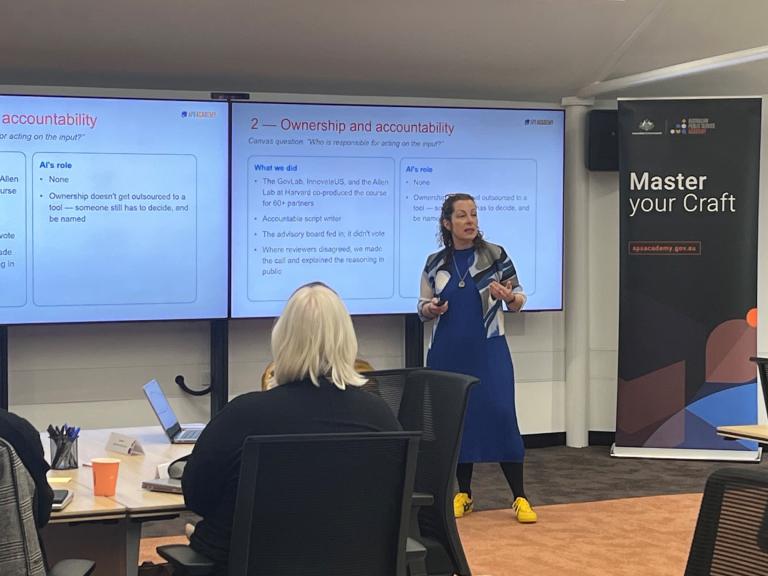
Professor Noveck is a global leader on the intersection between AI and government, focusing on how democratic institutions can utilise artificial intelligence to strengthen trust in government, improve civic engagement, and increase social cohesion, a concept she coined ‘Democratic AI’. As the second Australian Reformer Democracy Network Global Fellow, she is working with Australian partners to explore how AI can strengthen democratic engagement, improve participation in shared decision-making and support governments to listen and respond more effectively.
These themes were translated into practice through the Designing Democratic Engagement with AI workshop, which marked the world-first in-person delivery of the online course through a partnership with the APS Academy, Department of Home Affairs (Office of Social Cohesion), the Australian Resilient Democracy Network and GovLab.
Participants from 8 APS agencies explored practical ways to use AI to support public sector engagement. Working through real-world scenarios, they tested AI tools, assessed the quality of their outputs and considered how these approaches could strengthen engagement processes while maintaining trust and accountability. The workshop gave participants an opportunity to build confidence with emerging tools and reflect on how they could be applied responsibly in their own contexts.
A key insight from the workshop was that while there was strong interest from participants in using AI to enhance engagement work, there was a need to have access to fit-for-purpose tools and guidance to apply it confidently and responsibly.
Professor Noveck then joined 86 attendees, predominantly at the SES Band 3 level, for an SES AI Insights Series conversation, chaired by Dr Subho Banerjee, Deputy Commissioner, Head of APS Academy and Capability.
The conversation explored what AI means for today’s public sector leaders, including the opportunities it presents, the risks that need to be managed, and the capabilities leaders will need to develop in their teams. Professor Noveck also shared insights on what it means for government to become a better listening institution, and how AI could enable more meaningful forms of public engagement.
Professor Noveck emphasised that both engagement and the responsible use of AI are learned skills. For leaders, this means investing in their own learning, creating space for their teams to build capability, and focusing on how AI can improve practices rather than viewing it as an end in itself.
These events reinforced the importance of equipping leaders and practitioners with the skills, tools and confidence needed to use AI in ways that strengthen trust, participation and public value.
They also highlighted the value of partnerships that connect expertise from across government, academia and international networks to create practical learning experiences for the APS.
The APS Academy will continue partnering across the service to develop and scale practical learning opportunities that support public servants to apply AI confidently, responsibly and effectively in their day-to-day work.
For more on current AI interest areas, check out AI topics at the APS Academy.