

Learning culture toolkit: implementation guidance

Purpose of this guidance
This guidance supports APS agencies to adopt, adapt and embed the learning culture toolkit in ways that are practical, sustainable and aligned with agency priorities.
The toolkit is designed to help agencies:
- foster a continuous learning culture that supports individual and organisational performance
- embed learning into everyday work, not just formal training
- improve capability, adaptability and innovation across the APS
- strengthen leadership capability in fostering learning culture
- improve staff engagement, learning uptake and retention
- support organisational focus on workforce capability and elements of job and work redesign
- align learning initiatives with APS Reform and capability priorities.
This guidance recognises the diversity of APS agencies and encourages flexible implementation based on agency context, maturity and workforce needs.
Recommended implementation approach
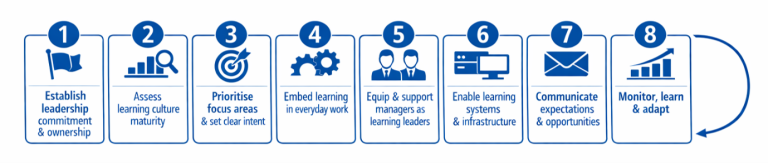
Step 1: Establish leadership commitment and ownership
What to do
- Nominate a Senior Executive sponsor accountable for progressing a learning culture.
- Identify a business owner (often People, Capability or Organisational Development teams).
- Clarify governance (for example, People Committee, Learning Board).
Good practice
- Include learning culture as a standing agenda item in executive forums.
- Link learning culture objectives to SES performance expectations.
- Reinforce that learning is core to delivering outcomes, not optional.
Step 2: Assess your agency’s learning culture maturity
What to do
- Review current approaches to learning using the toolkit.
- Assess strengths and gaps across:
- leadership behaviours
- learning systems and processes
- learning in teams and everyday work
- psychological safety and feedback
- Use qualitative insights as well as data (for example, staff feedback, APSC surveys).
Tip – Focus on understanding how learning actually happens, not just completing a formal training activity.
Tools
- Learning culture implementation checklist
- Learning culture maturity matrix
- Learning culture maturity snapshot
- Learning culture self-assessment tool
Step 3: Prioritise focus areas and set clear intent
What to do
- Identify 2 to 4 priority areas to focus on first (for example, manager capability, learning in projects).
- Articulate a clear agency intent for learning culture (for example, ‘learning in the flow of work’).
- Align priorities to:
- agency strategy and workforce plan
- capability gaps and future needs.
What to avoid
- Avoid trying to implement all toolkit elements at once.
- Avoid over reliance on courses as the primary solution.
Step 4: Embed learning into everyday work practices
What to do
Use the toolkit to embed learning into:
- team meetings and project cycles
- after action reviews and reflections
- job design and workforce planning
- communities of practice and mentoring.
Good practice
- Normalise reflection: ‘What did we learn?’ becomes standard.
- Use short, frequent learning moments rather than large programs.
- Recognise and reward learning behaviours.
Step 5: Equip and support managers as learning leaders
What to do
- Prioritise support for managers, who play a critical role in learning culture.
- Provide practical guidance on:
- coaching and feedback
- creating psychologically safe teams
- supporting learning through stretch and experience
- Use existing manager forums or capability frameworks.
Tip – Managers don’t need to be learning experts but they do need to enable learning.
Step 6: Enable learning systems and infrastructure
What to do
- Ensure learning systems support informal and social learning, not just courses.
- Review:
- learning management systems and platforms
- access to learning resources and communities
- data collected about learning and capability.
Integration focus
- Simplify where possible.
- Ensure systems reinforce learning behaviours rather than compliance.
Step 7: Communicate expectations and opportunities
What to do
- Clearly communicate:
- why learning culture matters
- what it looks like in practice
- what different roles are expected to do.
- Use leadership messaging, intranet and team channels.
Effective messages
- ‘Learning is how we improve outcomes.’
- ‘Everyone contributes to our learning culture.’
- ‘Learning happens every day, in every role.’
Step 8: Monitor, learn and adapt your approach
What to do
- Build learning culture monitoring into existing people and performance reporting.
- Use indicators such as:
- manager and employee confidence in learning
- use of learning practices (for example, reflection, coaching)
- capability uplift over time
- APS Census data.
- Regularly reflect on and refine your approach.
Note – Agencies are encouraged to share lessons learned across the APS.
Roles and responsibilities (indicative)
| Role | Responsibilities |
|---|---|
| Senior executive sponsor | Champion learning culture, role model behaviours |
| People or capability teams | Enable frameworks, tools and support |
| Managers | Embed learning into everyday work |
| Employees | Take ownership of learning and development |
| APSC | Provide toolkit, guidance and APS-wide insight |
Scaling implementation to agency context
Smaller agencies
- Focus on leadership behaviours and team practices
- Use informal learning mechanisms
- Leverage cross agency communities
Larger agencies
- Phase rollout across business areas
- Pilot learning practices before scaling
- Support consistency via shared frameworks
Operational or regulatory environments
- Embed learning into shifts, projects and casework
- Use short, practical learning and reflection
- Align learning to risk and decision quality
Common pitfalls and how to address them
| Pitfall | How to address |
|---|---|
| Learning equated only with training | Promote learning in work and reflection |
| Lack of time for learning | Embed learning into existing activities |
| Inconsistent manager support | Invest in manager capability |
| Tool overload | Integrate with existing systems |
| Low psychological safety | Reinforce leadership expectations |
Implementation checklist (APS agencies)
Use this checklist to plan, implement and embed a learning culture in a way that suits your agency's context, size and maturity.
1. Leadership and governance
- Senior executive sponsor identified and agreed
- Learning culture included in executive discussions or people-related governance
- Clear ownership assigned (for example, People, Capability or Organisational Development function)
- Roles and responsibilities defined for:
- executives
- managers
- employees
- Executive messaging confirms learning is core to business outcomes
2. Understanding your start point
- Current learning practices reviewed (formal and informal)
- Strengths in existing learning culture identified
- Gaps or barriers to learning identified
- Insights gathered from staff feedback (for example, engagement surveys and conversations)
- Findings documented and shared with relevant stakeholders
3. Setting clear priorities
- Learning culture intent defined (for example, 'learning in the flow of work')
- 2 to 4 priority focus areas identified
- Priorities aligned with:
- agency strategy
- workforce plan
- capability needs
- Scope agreed (what will and will not be implemented initially)
4. Embedding learning into everyday work
- Learning explicitly included in performance and development discussions
- Reflection embedded into:
- team meetings
- projects
- key activities or milestones
- Stretch and experiential learning opportunities identified
- Learning expectations communicated to managers and teams
- Existing work practices adapted rather than creating new processes
5. Supporting managers as learning leaders
- Managers briefed on their role in building learning culture
- Practical guidance provided to managers (not just frameworks)
- Learning expectations included in manager capability or performance discussions
- Managers supported to:
- coach and give feedback
- create psychologically safe teams
- encourage reflection and learning from experience
6. Learning systems and infrastructure
- Learning systems reviewed for alignment with learning culture goals
- Informal and social learning supported (not just courses)
- Learning resources accessible and easy to use
- Duplication of tools or platforms identified and addressed
- Data collection focused on value, not compliance
7. Communication and engagement
- Clear communication developed explaining:
- why learning culture matters
- what it looks like in practice
- what is expected of different roles
- Key messages tailored for:
- executives
- managers
- employees
- Existing communication channels used (for example, intranet and leadership updates)
- Positive learning behaviours recognised and reinforced
8. Monitoring and continuous improvement
- Success measures defined (qualitative and/or quantitative)
- Learning culture discussed as part of people or performance reporting
- Feedback collected from managers and employees
- Approach reviewed and adjusted over time
- Lessons learned shared internally (and across APS where appropriate)
9. Scaling and sustainability
- Implementation phased where appropriate
- Pilots evaluated before broader rollout
- Learning culture practices embedded into:
- workforce planning
- talent and leadership development
- change initiatives
- Ongoing ownership and governance confirmed
Final check
- Learning culture is positioned as part of work, not an extra task
- Managers understand their role and feel supported
- Learning practices reinforce APS values and ways of working
- Approach reflects agency context, size and risk profile
Maturity matrix
| Dimension | Foundation | Developing | Advanced |
|---|---|---|---|
| Leadership and governance | Learning supported in principle; sponsorship identified | Learning discussed in executive forums; clear accountability | Learning culture is an executive priority; SES visibly role-model it. |
| Learning culture intent | Learning culture discussed but not clearly articulated | Clear learning culture intent aligned to strategy | Learning culture is embedded in business, workforce and capability planning. |
| Understanding how learning happens | Focus on formal training activity | Informal and on-the-job learning recognised and reviewed | Continuous insight into learning impact guides decisions and investment. |
| Learning in everyday work | Learning mainly occurs through courses | Learning embedded in projects, meetings and reviews | Learning is normalised; reflection and improvement are routine. |
| Managers as learning leaders | Manager support varies and expectations are unclear | Managers supported to enable learning and development | Learning leadership is a core people-management capability. |
| Psychological safety and inclusion | Learning encouraged but risks not always safe to discuss | Open discussion and respectful challenge supported | People confidently speak up, experiment and learn from mistakes. |
| Learning systems and infrastructure | Systems focus on compliance and training | Systems support broader learning approaches | Systems actively enable learning in the flow of work. |
| Formal learning use | Formal learning used without strong connection to work | Formal learning linked to role needs and application | Formal learning strategically reinforces capability priorities. |
| Communication and reinforcement | Learning messages inconsistent and ad hoc | Clear messaging and recognition of learning behaviours | Learning stories and insights are actively shared and reinforced. |
| Monitoring and improvement | Limited monitoring; activity-focused | Learning culture included in people reporting | Learning culture is continuously reviewed and improved. |
Using the maturity matrix
Agencies are encouraged to:
- Focus on progression, not perfection
- Select a small number of priority areas to develop first
- Use the matrix to support:
- executive discussion
- implementation planning
- progress reflection over time.
Movement toward advanced maturity is typically driven by:
- visible leadership behaviours
- learning embedded in everyday work
- strong manager capability
- safe and inclusive learning environments.
Remember, in practice, resources can be flexibly applied across different maturity levels, depending on agency priorities and the stage of team development.