Skip to main content Skip to main navigation
Australian Public Service Academy Australian Public Service Academy Australian Public Service Academy Australian Public Service Academy logo

APSLearn logo

APSLearn Login

APS Professions logo
Professions MCP Portal

Main navigation

  • APS Craft

    APS Craft

    • Integrity
    • Working in Government
    • Engagement & Partnership
    • Implementation & Services
    • Strategy, Policy & Evaluation
    • Leadership & Management
  • APS Professions

    APS Professions

    • Complex Project Management Profession
    • Data Profession
    • Digital Profession
    • Evaluation Profession
    • HR Profession
    • Procurement and Contract Management Profession
  • APS People

    APS People

    • Diversity and Inclusion
    • Health and Wellbeing
    • Work Health and Safety
    • Your APS Career
  • APS Induction
  • Learning Experiences

    Learning Experiences

    • Courses
    • Course session dates
    • Microcredentials
    • Events
    • Resources
    • Cross Agency Training Hub
    • Nationwide course sessions
    • SES Executive Coaching
  • Our Services

    Our Services

    • APSLearn
    • APS Academy course offerings
    • APS Academy Training Venues
    • Onboard learning experiences
    • Share and reuse learning experiences
  • Guides

    Guides

    • APS L&D Good Practice Guide
    • Learning Design and Administration
    • Learning Culture
    • The Learner and Career Development
    • Learning Technologies
    • Procurement in L&D
    • Evaluating Learning
    • L&D Search
    • Content Strategy Guide
  • News

    News

    • Academy News
    • MyAcademy
  • About us

    About us

    • About the APS Professions
    • Faculty
    • Learning approach
    • Contact
    • Supplier FAQ's

Apply a content governance model

You are here

  1. Home
  2. Learning Experiences
  3. Resources
  4. Apply a content governance model
  • Linkedin
  • Twitter
  • Facebook
  • Email
Print

Work towards a content governance model to improve and report on, outcomes and efficiencies. There are 3 main types of content governance model.


Decentralised content governance model


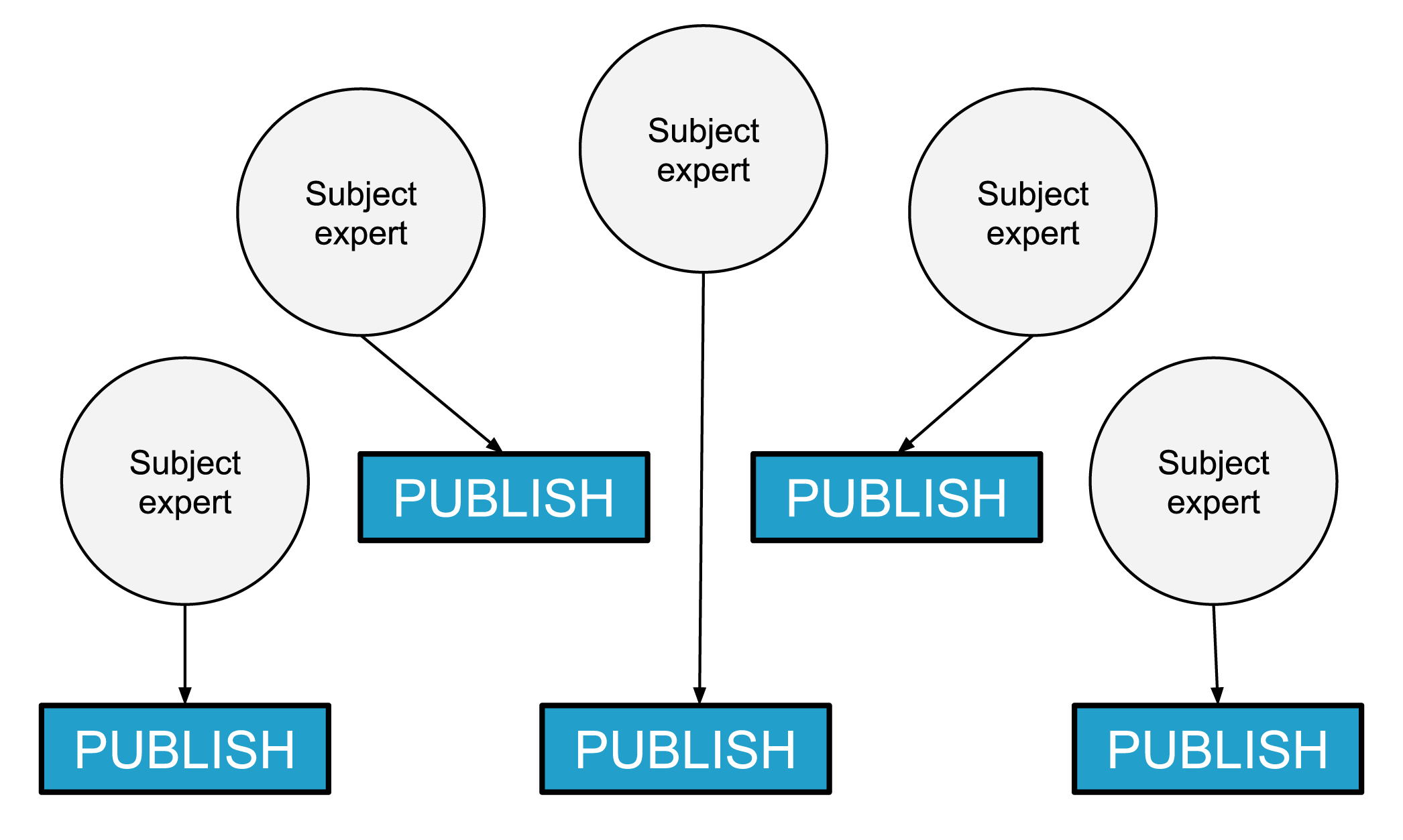
This model has the least content maturity. Subject experts create and publish their own content. They may also send their signed off content to a publishing team. This model can indicate a basic content maturity level with little or no strategy.

Pros: Faster content approval and publishing.

Cons: Managing content is localised. For example managing content in a business area rather than agency-wide. There may be a tendency to put business needs before user needs. It’s often impossible to oversee quality standards such as plain English, readability, and accessibility. It’s difficult to establish overall editorial consistency.

Diagram illustrating a decentralised content governance model. Multiple subject matter experts independently publish content through separate publishing pathways. Arrows connect each subject matter expert to an individual publishing function, showing that content creation and publishing responsibilities are distributed across different contributors rather than managed through a central authority.

All subject experts send content directly to publish or self-publish. the way.


Centralised content governance model


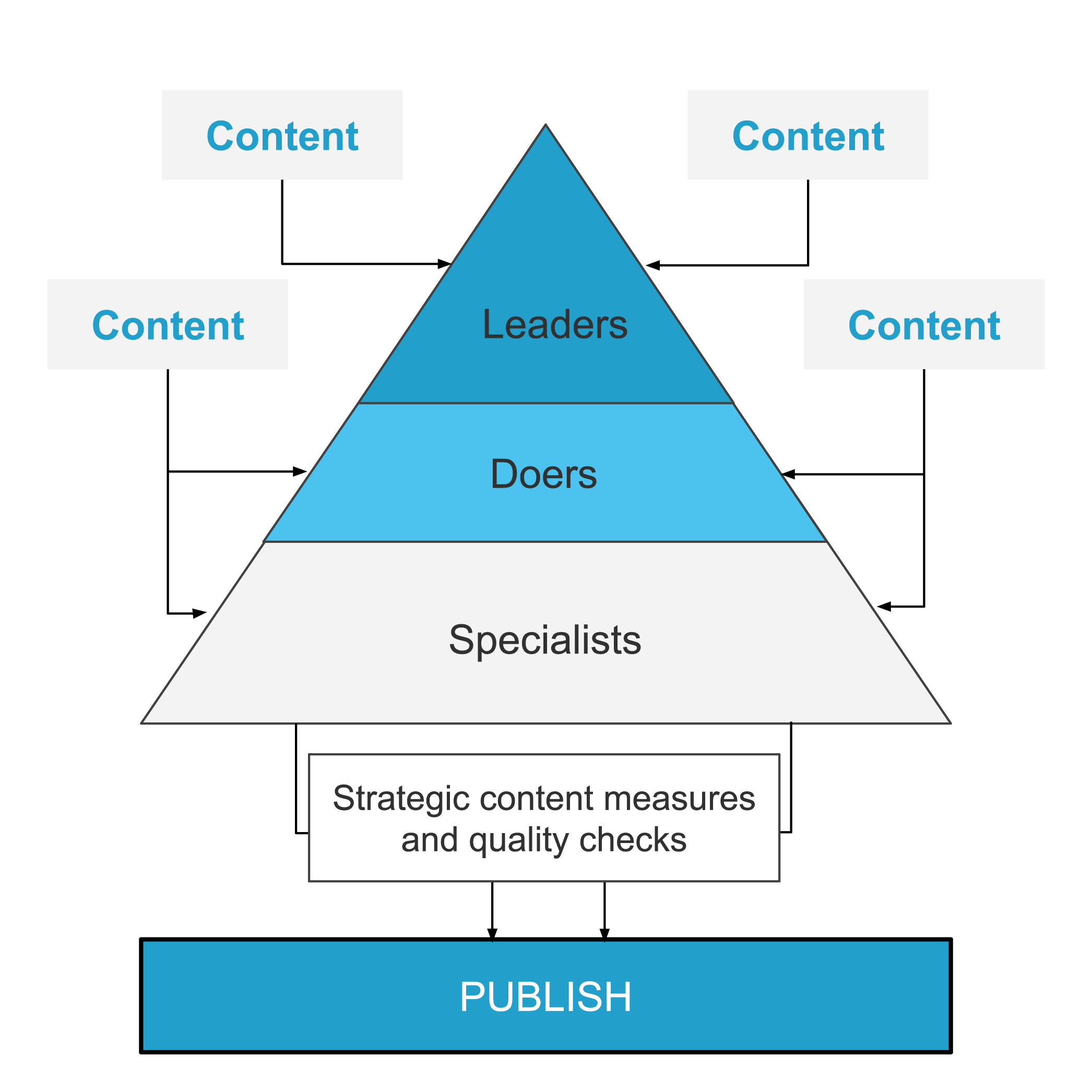
Centralised content governance brings a level of strategy, quality standards and a user-focused approach. A central content team oversees content. The team may also be responsible for high-profile services. These may be publishing teams who work on requests from subject experts.

Pros: A content strategy, supported by guidelines and templates, encourages capability building. This also helps to build a content community. Quality checks are part of the workflow to ensure continuous improvement.

Cons: Often a complex workflow. There can also be delays in negotiating and finalising content.

Centralised content governance model showing content flowing through a structured hierarchy of specialists, doers and leaders before publication. Multiple content sources feed into the governance framework, where strategic content measures and quality checks are applied before content is approved and published through a single publishing channel.

All content inputs point to a central team of leaders, doers and specialists.The output from the central team are strategic content measures and quality checks. These checks point straight to publish.


Hybrid content governance model


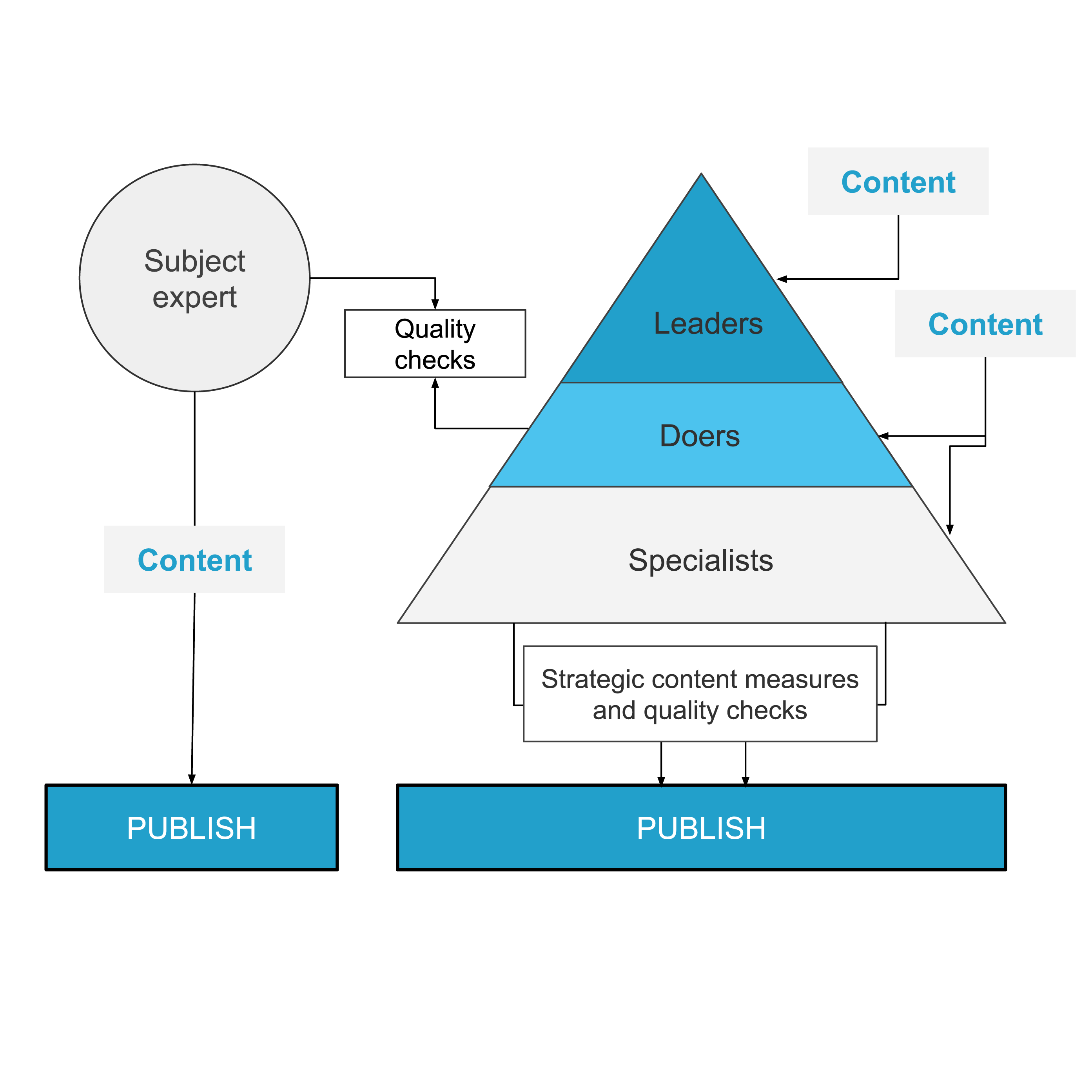
A hybrid content governance model works to improve content and efficiencies across extended teams. The central team’s focus is on high profile content meeting its strategic goals. The team ensures the quality of published content. They own the site's information architecture.

Other lower profile content, such as a careers section, may be decentralised. These teams could create and edit their own content, but not be able to add new pages. Depending on resources and their content expertise, they may be able to publish their own pages.

Pros: Lines of accountability and ownership extend from leaders to doers and specialists. This gives structure to specialists in extended teams.

The subject expert informs and defines the ‘what’ and the ‘why’. The content expert knows about the ‘how’ and the ‘where’. This creates a strong workflow, using content types and quality checks.

Cons: There needs to be strong governance and commitment from leaders. Without this roles and responsibilities can become unclear, and resources stretched. This model can be difficult to manage. It needs a lot of maintenance, communication and coordination

Hybrid content governance model combining centralised and decentralised publishing approaches. On one side, a subject matter expert publishes content directly with local quality checks. On the other, multiple content sources flow through a central governance structure of specialists, doers and leaders, where strategic content measures and quality checks are applied before publication. The diagram illustrates a balance between local ownership and central oversight.

Subject experts send content to the central team of leaders, doers and specialists. Content is returned with quality checks. The subject experts send content to be published or self-publish.

Content is sent directly to the central team of leaders, doers and specialists. The outputs from the central team are strategic content measures and quality checks. These checks point straight to publish.

L&D Section
Set up your governance
L&D Groups
Develop your strategy
L&D Categories
Content Strategy Guide
Was this page helpful?
Last updated
25 September 2026

Acknowledgement of Country

The APS Academy acknowledges the Traditional Custodians of Country throughout Australia and recognises the continuing connection to lands, waters and communities.
We pay our respect to Aboriginal and Torres Strait Islander cultures and to Elders both past and present.

Museum of Australian Democracy
Old Parliament House 
Parkes 2600

APSLearn terms & conditions

About us

apsacademy@apsc.gov.auContact us
ABN: 99 470 863 260 
  • LinkedIn - external site - external site - external site

Help us improve

We are always looking for ways to improve the user experience of our website

 Share your thoughts

  • © 2021 APS Academy. All rights reserved.
  • FOI
  • Privacy Policy 
  • Terms of use
  • Accessibility
Back to top